From Headquarters to Hub: How Smart Enterprises Are Reimagining the Role of Physical Space
For decades, the corporate headquarters served as a statement. Floor count signaled ambition. Corner offices communicated hierarchy. The address on a business card carried weight. Then came a fundamental disruption—not a slow evolution, but a forced experiment that millions of American workers and their employers conducted simultaneously—and the statement changed entirely.
Hybrid work is no longer a trend under observation. It is a permanent feature of the American enterprise landscape. According to data from McKinsey & Company, more than half of U.S. workers with desk-based roles now operate in some form of hybrid arrangement. That shift has cascading consequences for commercial real estate, workplace culture, and the strategic decisions that executive teams face every quarter.
The question is no longer whether to reduce physical footprint. For most organizations, that conversation is already settled. The more consequential question is: what do you do with the space you choose to keep?
The Downsizing Wave and Its Limits
Major U.S. employers have been shedding office space at a pace not seen since the 2008 financial crisis. Cities like San Francisco, Chicago, and New York have recorded commercial vacancy rates that would have seemed implausible in 2019. Sublease inventory has ballooned. Some organizations have exited long-term leases entirely, absorbing penalty costs as the more palatable option compared to maintaining underutilized real estate.
Yet a quieter story is unfolding alongside the headline-grabbing lease terminations. Companies that moved too aggressively toward fully remote models are now confronting measurable costs that rarely appear on a balance sheet. Onboarding timelines have stretched. Mentorship relationships have eroded. Cross-functional collaboration—the kind that produces genuine innovation—has proven stubbornly resistant to replication through video calls and project management platforms.
The assumption that remote-first automatically means office-less has, in many enterprises, collided with operational reality.
What the Data Actually Says About Gathering
Research published by Stanford economist Nicholas Bloom and colleagues consistently points to a nuanced picture. Fully remote workers report higher individual productivity on focused, independent tasks. However, teams working in proximity—even intermittently—demonstrate stronger rates of creative problem-solving, faster conflict resolution, and more durable professional relationships.
The implication for enterprise leaders is not that remote work is inferior. It is that different categories of work have different spatial requirements. Execution often thrives in distributed environments. Strategy, culture-building, and complex collaboration frequently do not.
This distinction is driving a fundamental redesign of what the office is supposed to accomplish. Organizations that once measured success in workstations per floor are now measuring it in collaboration outcomes per visit.
The Intentional Collaboration Hub Model
The most adaptive enterprises are not simply shrinking their offices. They are reconceiving them. The emerging model—sometimes called the collaboration hub or activity-based workplace—treats physical space as a tool with a specific job description rather than a default container for headcount.
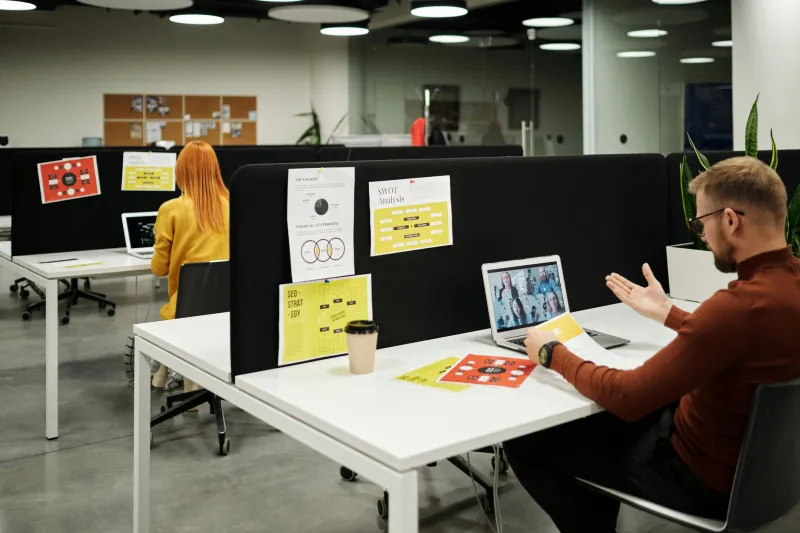
In practical terms, this means fewer assigned desks and more varied environments designed for specific work modes: open areas for team workshops, quiet zones for focused individual work during in-office days, and well-equipped conference infrastructure for hybrid meetings where some participants are remote. The goal is to make coming into the office feel meaningfully different from working at home—not merely a geographic change, but a functional one.
Companies like Salesforce and Microsoft have invested substantially in reconfiguring their domestic office portfolios along these lines, reducing total square footage while increasing investment per square foot in the environments that remain.
The Downtown Commercial District Problem
The ripple effects of this transformation extend well beyond individual corporate real estate strategies. Downtown commercial districts in major U.S. metros are grappling with a structural challenge that conventional economic cycles do not fully explain. When anchor employers reduce their footprint or shift to hub-and-spoke models with satellite offices in suburban locations closer to where employees actually live, the downstream impact on local restaurants, transit systems, retail, and service businesses is substantial.
City planners and commercial landlords are beginning to respond with adaptive reuse strategies—converting underperforming office towers into residential units, mixed-use developments, and life sciences facilities. These transitions take time, capital, and regulatory flexibility that varies significantly by jurisdiction. The adjustment period, by most estimates, will extend well into the next decade.
For enterprise leaders, this context matters. Decisions about where to locate a collaboration hub—and whether that location remains a downtown address or shifts toward a suburban campus—carry implications not just for employee commute patterns but for community relationships and talent pipelines.
Culture Cannot Be Archived
Perhaps the most underappreciated risk in the rush to optimize real estate costs is what happens to organizational culture when physical presence becomes purely optional and entirely unstructured.
Culture is not transmitted through an employee handbook or a values slide in an all-hands presentation. It is absorbed through observation—watching how a senior leader handles a difficult conversation, how a high-performing team navigates disagreement, how an organization actually behaves when no one is writing a policy about it. These moments require proximity, even if that proximity is periodic rather than daily.
Enterprises that treat office attendance as purely an individual preference, with no intentional design around when and why teams gather, often discover that their culture has quietly diverged from their stated values. New hires, in particular, struggle to integrate into a culture they have never had the opportunity to observe in person.
Designing the Office Your Teams Will Actually Use
The organizations navigating this transition most successfully share a common approach: they treat the office as a product to be designed, not a cost to be minimized. That means soliciting employee input on what draws them in, investing in the technology infrastructure that makes hybrid meetings equitable rather than frustrating, and establishing clear organizational norms around when in-person presence is expected and why.
It also means resisting the temptation to let real estate decisions drive culture decisions. The sequence matters. Define what the office needs to accomplish for your workforce and your business objectives. Then determine how much space, in what configuration, and in what locations, supports that purpose. The inverse approach—cutting space first and hoping culture adapts—has produced predictably inconsistent results.
The office is not obsolete. It has simply been given a more specific and more demanding job. The enterprises that understand that distinction are the ones building workplaces worth the commute.